
- Home
- Products
- Knowledge Base
- Sales
- Customer Support
- Contact Us
- Order Desk: 866-216-8700
Welcome to ASD! Call us at 866-216-8700 to place your order today.
 |
What is Ozone? |
|||||
|
Monday 19 August, 2013.
 |
|||||
|
Depending on where ozone resides, it can protect or harm life on Earth. Most ozone resides in the stratosphere (a layer of the atmosphere between 10 and 40 km above us), where it acts as a shield to protect Earth's surface from the sun's harmful ultraviolet radiation. With a weakening of this shield, we would be more susceptible to skin cancer, cataracts, and impaired immune systems. Closer to Earth in the troposphere (the atmospheric layer from the surface up to about 10 km), ozone is a harmful pollutant that causes damage to lung tissue and plants. The amounts of "good" stratospheric and "bad" tropospheric ozone in the atmosphere depend on a balance between processes that create ozone and those that destroy it. An upset in the ozone balance can have serious consequences for life on Earth, as scientists are finding evidence that changes are occurring in ozone levels—the "bad" tropospheric ozone is increasing in the air we breathe, and the "good" stratospheric ozone is decreasing in our protective ozone layer. This article describes processes that regulate "good" ozone levels. In the stratosphere, ozone is created primarily by ultraviolet radiation. When high-energy ultraviolet rays strike ordinary oxygen molecules (O2), they split the molecule into two single oxygen atoms, known as atomic oxygen. A freed oxygen atom then combines with another oxygen molecule to form a molecule of ozone(O3). There is so much oxygen in our atmosphere, that these high-energy ultraviolet rays are completely absorbed in the stratosphere. The relative heights of atmospheric layers Ozone is extremely valuable since it absorbs a range of ultraviolet energy. When an ozone molecule absorbs even low-energy ultraviolet radiation, it splits into an ordinary oxygen molecule and a free oxygen atom. Usually this free oxygen atom quickly re-joins another oxygen atom to form another ozone molecule. Because of this "ozone-oxygen cycle," harmful ultraviolet radiation is continuously converted into heat.
Natural reactions other than the "ozone-oxygen cycle" described above also affect the concentration of ozone in the stratosphere. Because ozone and free oxygen atoms are highly unstable, they react very easily with nitrogen, hydrogen, chlorine, and bromine compounds that are found naturally in Earth's atmosphere (released from both land and ocean sources). For example, single chlorine atoms can convert ozone into oxygen molecules and this ozone loss balances the production of ozone by high-energy ultraviolet rays striking oxygen molecules. In addition to the natural ozone balance, scientists have found that ozone levels change periodically as part of regular natural cycles such as the changing seasons, winds, and long time scale sun variations. Moreover, volcanic eruptions may inject materials into the stratosphere that can lead to increased destruction of ozone. Over the Earth's lifetime, natural processes have regulated the balance of ozone in the stratosphere. A simple way to understand the ozone balance is to think of a leaky bucket. As long as water is poured into the bucket at the same rate that water is leaking out, the amount or level of water in the bucket will remain the same. Likewise, as long as ozone is being created at the same rate that it is being destroyed, the total amount of ozone will remain the same. Starting in the early 1970's, however, scientists found evidence that human activities were disrupting the ozone balance. Human production of chlorine-containing chemicals such as chlorofluorocarbons (CFCs) has added an additional factor that destroys ozone. CFCs are compounds made up of chlorine, fluorine and carbon bound together. Because they are extremely stable molecules, CFCs do not react easily with other chemicals in the lower atmosphere. One of the few forces that can break up CFC molecules is ultraviolet radiation. In the lower atmosphere, CFCs are protected from ultraviolet radiation by the ozone layer itself. CFC molecules thus are able to migrate intact up into the stratosphere. Although the CFC molecules are heavier than air, the air currents and mixing processes of the atmosphere carry them into the stratosphere. Once in the stratosphere, the CFC molecules are no longer shielded from ultraviolet radiation by the ozone layer. Bombarded by the sunÕs ultraviolet energy, CFC molecules break up and release chlorine atoms. Free chlorine atoms then react with ozone molecules, taking one oxygen atom to form chlorine monoxide and leaving an ordinary oxygen molecule.
If each chlorine atom released from a CFC molecule destroyed only one ozone molecule, CFCs would pose very little threat to the ozone layer. However, when a chlorine monoxide molecule encounters a free atom of oxygen, the oxygen atom breaks up the chlorine monoxide, stealing the oxygen atom and releasing the chlorine atom back into the stratosphere to destroy more ozone. This reaction happens over and over again, allowing a single atom of chlorine to act as a catalyst, destroying many molecules of ozone. Fortunately, chlorine atoms do not remain in the stratosphere forever. When a free chlorine atom reacts with gases such as methane (CH4), it is bound up into a molecule of hydrogen chloride (HCl), which can be carried downward from the stratosphere into the troposphere, where it can be washed away by rain. Therefore, if humans stop putting CFCs and other ozone-destroying chemicals into the stratosphere, the ozone layer eventually may repair itself. Graphics are courtesy of NASA |
|||||
 |
|||||
|
|||||
|
|||||
|



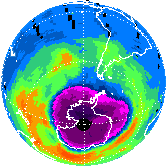 Ozone (O3) is a relatively unstable molecule made up of three atoms of oxygen (O). Although it represents only a tiny fraction of the atmosphere, ozone is crucial for life on Earth.